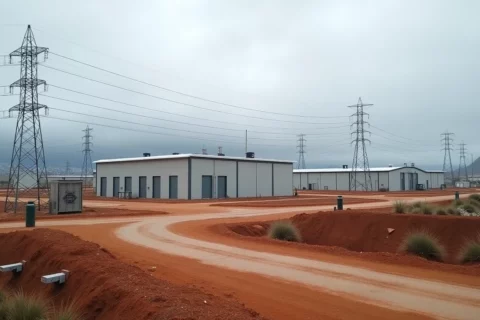

The cloud boom looks like industrial policy with better branding. AWS has put R30.4 billion on the table for local infrastructure, Microsoft has committed R5.4 billion to hyperscale cloud and AI capacity, and Google has added a Johannesburg Cloud Region while backing African connectivity and skills work. Officials now describe the market as the continent’s largest cloud hub, with a heavy share of hyperscale data-centre capacity. Once the racks arrive, what actually stays onshore?
Not much of the hardware spend itself. Servers, chips, storage, switching gear, custom racks, and specialist cooling systems are designed and bought through global supply chains, then landed here. Local value is real, but it sits around the edges of the build, in civils, electrical work, cabling, security, cleaning, maintenance, facilities management, and the people keeping the site alive once the ribbon has been cut. This is a commercial ecosystem, not yet a domestic hardware industry.
What changed
A cloud region changes the economics of digital product building before it changes the country’s balance sheet. Lower latency helps payment systems, media platforms, logistics apps, and anything else that needs response times measured in milliseconds. Data residency also stops being a constraint in sectors that care about where information lives.
The bigger shift is access. Startups and smaller firms no longer need to buy their own server rooms before they can test an idea. They can rent capacity, burst when demand spikes, and use higher-end services such as AI, machine learning, analytics, and serverless tools without carrying the capital cost of owning the stack. AWS Activate, Microsoft for Startups, and Google for Startups all push credits, support, and mentoring into the market. This lowers the entry barrier, especially for teams that can build but cannot finance a room full of equipment.
What stays local
The strongest local gains are in labor and procurement, not ownership of the technology itself. During construction, the spend feeds engineers, contractors, and suppliers. During operations, it supports data-centre technicians, network engineers, electrical specialists, security teams, and facilities staff. AWS has said its R30.4 billion plan should support an average of 5,700 full-time jobs a year, direct and indirect, across a 10-year period. Microsoft has not published a comparable job estimate for its R5.4 billion commitment, but the pattern is the same. The job mix is technical, narrow, and valuable, but it is not mass employment.
Electricity is the harder question. Hyperscale sites consume serious power, often hundreds of megawatts for a region, which puts pressure on an already strained grid. They also push renewable purchasing into the center of the conversation because these companies want cleaner supply and often sign long-term power deals with independent producers. AWS has already linked local activity to renewable investment, including a 10MW solar project in the Northern Cape. If those deals add new generation, they help. If they just draw from an already tight system, the cloud build-out becomes another hungry customer on an overloaded network.
What happens next
The local economy keeps the parts it can actually do well. It loses most of the compute spend because the core service, the intellectual property, and the profit chain sit offshore with the hyperscaler. What remains is wages, local supplier payments, utility bills, taxes, and the downstream business activity created by cheaper and faster cloud access. This is not trivial, but it is not the same thing as owning the industry.
The mistake in the current hype cycle is treating imported infrastructure as proof of domestic capability. A Johannesburg region is useful because it reduces friction for builders, gives enterprises a local endpoint, and makes more products viable. It does not automatically create a South African cloud manufacturing base, and it does not keep most of the revenue inside the country. The real scorecard is narrower: how many high-skill jobs get built, how much procurement lands with local firms, whether the power draw helps finance new generation, and how much of the cloud bill ends up circulating here instead of disappearing into offshore accounts.